


Anniversary of .срб Domain Marked and Almono RNIDS Gifted to the Internet Community
28.01.2026.
Read more
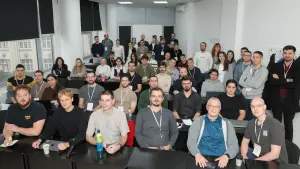
Team Dogma won the DNS SEC(urity) Hackathon, organised by the Serbian National Internet Domain Registry Foundation (RNIDS) on 31 October and 1 November at the Faculty of Computing in Belgrade. The Penguins of Madagascar took second place, while NXDOMAIN came third.
Jovana, Stefan and Aleksa, members of Dogma and second‑year students at the Faculty of Computing, developed the solution that received the highest overall score from the jury. Their tool, hijackscan, identifies domains for which a BGP hijack could enable the unauthorised issuance of a digital certificate, assesses the risk and recommends protective measures.
The second‑place team, The Penguins of Madagascar, consisted of Emilija, Minja, Strahinja and Nikola, students at the Faculty of Electrical Engineering in Belgrade. Some of them have already begun their professional careers. At the hackathon, they developed DNSSEC FlightCheck, a solution that checks whether planned DNSSEC key changes could make a domain unavailable and suggests a safer schedule for those changes.
The third‑place team, NXDOMAIN, consisted of Ilija, Lazar and Đorđe, graduates of the Faculty of Electrical Engineering and the Faculty of Computing who have recently started working at technology companies. They presented SplitTrust, a solution that checks whether a domain registrant has authorised the use of a private DNS resolver and prevents false DNS responses from being accepted on untrusted networks.
The jury, comprising representatives of Netnod, ICANN, RNIDS and the Faculty of Computing, assessed each team’s presentation, the innovation and practical value of its technical solution, and the quality of the engineering work behind it.
The hackathon was more than an intensive 24‑hour competition. It began with team applications: 57 teams applied, representing more than 200 potential participants. Ulrich Wisser of ICANN then held two preparatory webinars on DNS security for everyone who had applied.
The teams subsequently submitted proposals for the projects they planned to develop during the hackathon. The jury received 33 proposals and assessed their feasibility, practical value and creativity. Ten teams were selected for the final round.
On 31 October and 1 November, the finalists worked on their solutions with support from mentors representing Netnod, ICANN and RNIDS. At the end of the competition, they presented their work to the jury, whose scores determined the three highest‑ranked teams.
Meeting and connecting with other young people was also an important part of the final round. Participants said they had gained new knowledge and insights, as well as useful advice from the mentors.
DNS is one of the internet’s fundamental services, yet it often receives too little attention in the formal education of future IT professionals. Gaps in DNS protection and a lack of knowledge about available safeguards can threaten the availability of services and users’ trust in them.
The hackathon gave young engineers an opportunity to address these challenges with expert support and develop solutions that could contribute to more secure DNS infrastructure, benefiting both their future employers and internet users.
RNIDS’s partners in organising the DNS SEC(urity) Hackathon were RIPE NCC, Netnod, ICANN and the Faculty of Computing (RAF).
RIPE NCC supports the infrastructure of the Internet through technical coordination in Europe, the Middle East and parts of Central Asia. It is responsible for allocating and registering blocks of Internet number resources, including IPv4 and IPv6 addresses and Autonomous System Numbers (ASNs).
Netnod ensures a stable and secure internet across the Nordics and beyond by providing technology, expertise, and legislative insights to build a more resilient and robust internet.
ICANN is internationally organized, non‑profit corporation that has responsibility for Internet Protocol (IP) address space allocation, protocol identifier assignment, generic (gTLD) and country code (ccTLD) Top‑Level Domain name system management, and root server system management functions. Ulrich Wisser, ICANN’s Technical Engagement Manager for Europe, will lead preparatory webinars on DNS and DNSSEC for hackathon participants.
School of Computing (RAF) combines theoretical knowledge, practical work and new technologies to help students develop skills across different areas of the IT industry. It will host the teams in Belgrade for the final stage of the hackathon.
Photo: TwoTech Solutions
28.01.2026.
Read more

15.09.2025.
Read more

31.03.2025.
Read more

18.02.2025.
Read more

13.02.2025.
Read more

28.01.2025.
Read more

31.01.2024.
Read more

26.01.2024.
Read more

08.05.2023.
Read more

10.04.2023.
Read more

10.03.2023.
Read more

08.03.2023.
Read more
